
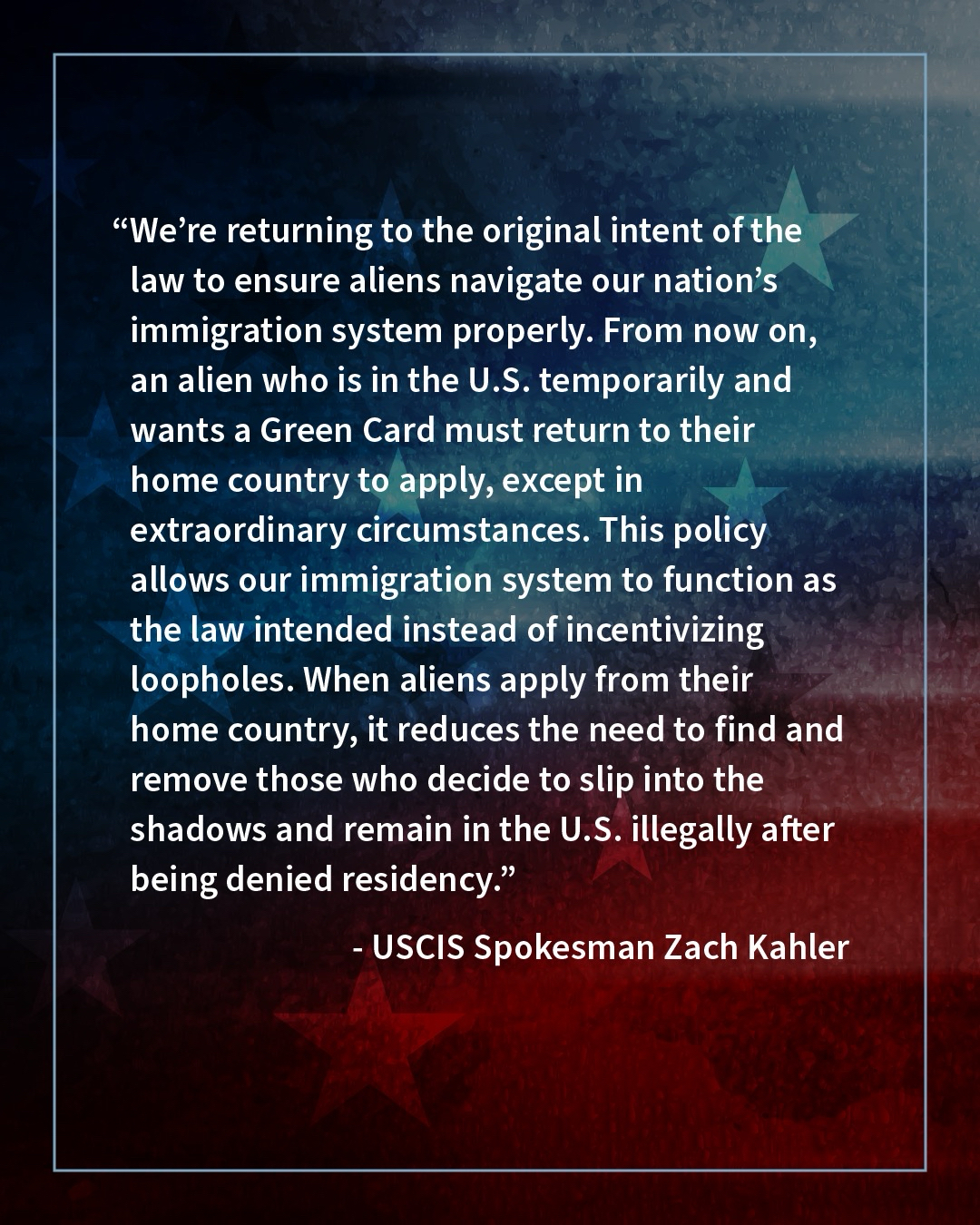
USCIS issued Policy Memorandum PM-602-0199 on May 21, 2026, and publicly announced the policy on May 22, 2026. The memorandum directs USCIS officers to treat adjustment of status in the United States as an "extraordinary discretionary benefit" when the applicant could apply for an immigrant visa through a U.S. embassy or consulate abroad.
In practice, USCIS is saying that many people who enter the United States on a temporary visa should generally return to their home country if they later want permanent residence. The memo is written broadly. Its guidance applies when consular processing is available, which means it reaches many family- and employment-based green card applicants who would historically have relied on adjustment of status after a lawful entry.
Historically, an individual present in the United States on a nonimmigrant visa, such as a visitor visa or student visa, could often adjust status in the United States after marrying a U.S. citizen, even after an overstay. Employment-based applicants in H-1B, L-1, and other statuses have also used adjustment when a visa number became available. The statutory adjustment rules still exist, but USCIS is now telling officers to deny adjustment unless the applicant can show that the case deserves favorable discretion.
This new policy is particularly serious for people who have overstayed by more than six months or by more than a year. USCIS says they should generally leave and apply for an immigrant visa abroad. For someone who has accrued unlawful presence, leaving the United States may trigger the three- or ten-year unlawful-presence bar. That can keep families separated for years.
It is also serious for applicants who are still in lawful nonimmigrant status. The memo's operative instruction is tied to the availability of consular processing, with or without unlawful presence or a status violation. Read that way, PM-602-0199 is close to a shutdown of routine adjustment of status whenever USCIS believes the applicant can finish the immigrant visa process abroad.
What changed
Adjustment of status has always involved discretion in most cases. USCIS already instructs officers to weigh positive and negative factors in its Policy Manual chapter on adjustment discretion. PM-602-0199 changes the way that discretion is likely to be used.
The memorandum repeatedly describes adjustment of status as an exception to the ordinary immigrant visa process. USCIS says Congress expected nonimmigrants and parolees to leave the United States when the purpose of their temporary admission or parole ended. When that person stays and asks for a green card inside the United States, USCIS now says the officer should treat that choice as a negative factor.
That matters because many adjustment cases have been prepared around eligibility. If the person entered lawfully, had an approved immigrant petition, had no serious criminal history, and could prove the underlying family or employment relationship, the adjustment case often moved forward as a regular I-485 filing. Under this memorandum, the same facts may no longer be enough.
The applicant may be eligible to file Form I-485 and still lose on discretion because USCIS believes the person should complete consular processing instead.
Why overstays are exposed
The memorandum identifies several facts USCIS officers should consider: failure to maintain status, violation of parole conditions, fraud or false testimony, unauthorized work, conduct inconsistent with the purpose of the original visa or parole, and failure to depart the United States when expected.
For an overstay adjustment case, those factors can be present even in a marriage case with no criminal history. A person enters as a visitor, student, temporary worker, or parolee. The period of admission ends. The person remains in the United States. The person later marries a U.S. citizen or otherwise becomes eligible for an immigrant visa. Under the new policy, USCIS can say the applicant should have finished the immigrant visa process abroad instead of using Form I-485 inside the United States.
The same consular-processing objection can reach applicants who have maintained status. The memo tells officers that, where consular processing is available, adjustment should be treated as extraordinary relief from the regular immigrant visa process. That instruction reaches beyond people with an overstay.
That is the risk. USCIS may approve the family petition and still deny the green card application because the officer concludes that the applicant did not merit the extraordinary discretionary benefit of adjustment.
Cases with the highest risk
The highest-risk cases are likely to be cases where the adjustment application looks like a direct conversion from temporary entry to permanent residence, especially after the person stopped complying with the terms of admission or parole.
That includes recent visitor-to-marriage cases, student cases after a status lapse, parole-to-adjustment cases after the reason for parole has ended, and cases involving unauthorized employment. It also includes cases where the person remained in the United States because leaving would trigger a three- or ten-year bar.
Those facts are common in real family cases. They are also why the memorandum is so serious. For years, adjustment has often been the safer option for a spouse, parent, or minor child of a U.S. citizen who entered lawfully and then overstayed. Leaving the United States can trigger unlawful-presence bars. Domestic adjustment avoided that immediate problem. USCIS is now signaling that avoiding consular processing may itself be part of the discretionary problem.
Employment-based cases need careful review as well. The memorandum acknowledges dual-intent categories, but that language is narrow. USCIS says only that applying for adjustment while maintaining dual-intent nonimmigrant status is not inconsistent with that status. Footnote 20 then says lawful dual-intent status is insufficient, by itself, to justify favorable discretion.
That footnote is critical. Dual intent may answer one narrow status-inconsistency argument. It leaves untouched the memo's larger objection that the applicant is asking USCIS to skip the ordinary consular immigrant visa process. Under PM-602-0199, an in-status H-1B or L-1 applicant still has to justify why domestic adjustment should be granted instead of consular processing.
Some cases need separate analysis
The memorandum acknowledges exceptions. Some nonimmigrant categories allow dual intent. Some immigrant categories are designed around adjustment of status. Some humanitarian categories have their own statutory structure.
VAWA, T and U visas, refugee and asylee adjustment, SIJ, 245(i), Afghan and other special immigrant categories, and cases involving military-related equities may require a different analysis. Some adjustment provisions are non-discretionary or have category-specific discretion rules. USCIS also says it may issue additional category-specific guidance.
For ordinary adjustment after a temporary admission, the direction of the policy is clear. USCIS wants officers to treat domestic adjustment as exceptional when consular processing is available.
What applicants should do now
An adjustment filing can no longer be prepared as a basic forms package. The record needs to address discretion, including why USCIS should grant domestic adjustment instead of requiring consular processing.
That means documenting the full immigration history, the purpose of the original entry, whether the applicant maintained status, whether there was unauthorized employment, whether the applicant made any statement to a consular officer or border officer that conflicts with the current green card case, and why adjustment inside the United States is justified.
The answer may involve hardship to U.S. citizen relatives, medical issues, U.S. citizen children, long residence before the violation, safety concerns abroad, military service, or a complicated waiver or consular-processing problem. In some cases, the honest answer may be that adjustment is now significantly riskier than the family expected.
People in removal proceedings, people with prior orders, and people with long unlawful-presence histories need a separate analysis before filing anything. Adjustment can interact with deportation defense in ways that depend on the court, the case history, and the person's full immigration record.
If you are deciding whether to file Form I-485 in the United States or finish the case abroad, treat that decision as a serious legal-risk analysis. Review the immigration history first, then compare adjustment risk, consular-processing risk, unlawful-presence bars, waiver options, and enforcement exposure. If you want a case-specific assessment, schedule a consultation.
Sources: USCIS Policy Memorandum PM-602-0199, May 21, 2026; USCIS news release, May 22, 2026; USCIS post on X, May 22, 2026; USCIS Director Joseph B. Edlow on X; Department of Homeland Security on X; USCIS unlawful presence and inadmissibility page; USCIS Policy Manual, Volume 7, Part A, Chapter 10; USCIS Adjustment of Status page; USCIS Form I-485 page.
Chris Hammond is a Houston immigration attorney focused on family-based green cards, adjustment and consular strategy, and deportation defense.